Top Firewall Log Monitoring Challenges Enterprises Face

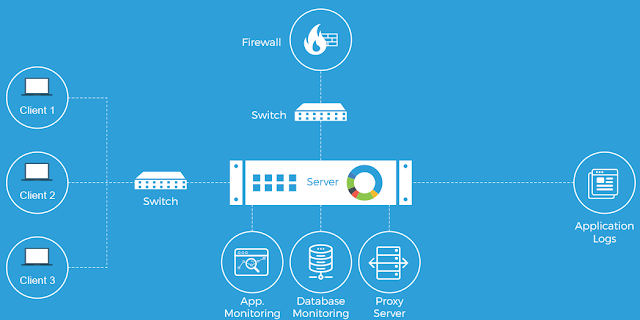
Firewalls
are the digital gatekeepers of the modern enterprise network, acting as the
first line of defense against an ever-evolving threat landscape. Yet, the real
work doesn't stop with deployment. The colossal volume of logs they
generate—recording every connection attempt, rule hit, and policy change—is an
invaluable source of security intelligence.
However,
extracting this value is a Herculean task. Enterprise-level firewall log monitoring
presents a unique set of challenges that can often leave security teams
overwhelmed, leading to blind spots, delayed threat response, and costly
compliance issues. This article dives deep into the top operational and
technical hurdles organizations face in effective firewall log monitoring.
1. The Sheer Volume and Velocity of Log Data
The
single greatest challenge for any enterprise is the Scale of the Data.
In large, high-traffic environments, a firewall can generate billions of log
entries daily. This creates several immediate operational and financial
problems:
- Log Overload and Noise: The vast majority of log
entries are benign "allow" or routine "deny" traffic.
Identifying the handful of critical security events—the
"needles"—within this massive haystack of "noise" is
exceptionally difficult, often exceeding a security analyst's capacity.
- Analyst Fatigue: This constant deluge of
low-value alerts leads to alert fatigue, causing teams to become
desensitized and potentially miss genuine, high-priority threats.
- Storage and Compute Costs: Log volume directly
correlates with soaring costs for storage, indexing, and processing power,
especially when using Security Information and Event Management (SIEM)
systems. As traffic grows, so does the IT budget strain.
- Performance Bottlenecks: Inefficient ingestion and
processing of logs can lead to performance issues and latency, slowing
down the very analytics systems intended to secure the network.
2. Lack of Standardization and Data Inconsistency
Enterprises
rarely run a single firewall vendor. Hybrid environments often involve an
intricate mix of vendors (Cisco, Palo Alto Networks, Check Point, Fortinet), as
well as cloud-native firewalls (AWS Security Groups, Azure Firewall). This
heterogeneity introduces a significant data challenge:
- Parsing and Normalization: Each firewall vendor
formats its logs differently. A log field for "Source IP
Address" in one system might be called something entirely different
in another. Before effective correlation can happen, all logs must be
collected, parsed, and normalized into a common, searchable format.
This process is complex, time-consuming, and prone to error.
- API and Protocol
Differences: Log
collection mechanisms—whether Syslog, proprietary APIs, or cloud-specific
connectors—vary widely, requiring security teams to maintain numerous
custom integrations.
- Missing Context: Logs from the firewall
alone often lack the necessary context (e.g., the specific user involved,
the business application, or the asset's vulnerability score) to determine
if an event is a true threat or a false positive.
3. Misconfigurations and Rule Bloat
The
firewall's operational state is intrinsically linked to the quality of its
logs. Errors in configuration often manifest as monitoring challenges:
- Insufficient Logging: A common and dangerous
challenge is simply not logging the right events. Some
organizations disable logging for high-volume, low-priority rules to save
space, but this can create a severe blind spot if a malicious actor begins
exploiting that traffic. Conversely, overly verbose logging for routine
traffic increases noise.
- Rule Bloat and Redundancy: Over years of changes,
firewall rulesets become riddled with obsolete, redundant, or
"shadowed" rules (rules that are never hit because an earlier,
broader rule catches the traffic first).
- Security Risk: These zombie rules create
unnecessary attack surfaces and make the ruleset—and thus the logs it
generates—far harder to interpret and audit.
- Tracking Rule Changes: A single, incorrect rule
change—a common cause of breaches—can open up a vulnerability. Without a
robust log monitoring system that diligently tracks and alerts on administrative
changes to the rule base, proving non-repudiation and tracing the
cause of a breach becomes nearly impossible.
4. Limited Deep-Packet Visibility (Encrypted
Traffic)
The rise
of end-to-end encryption (TLS/SSL) has dramatically complicated firewall log
analysis:
- The Encryption Blind Spot: When traffic is encrypted,
the firewall can see the source, destination, and port, but it cannot
inspect the payload for malicious content like malware or data
exfiltration attempts. This creates a critical blind spot in the logs.
- Decryption Overhead: While Next-Generation
Firewalls (NGFWs) offer SSL/TLS decryption capabilities, implementing them
for deep inspection is resource-intensive. It can lead to significant
network slowdowns and performance issues, making many enterprises hesitant
to enable it across all traffic. The logs, therefore, only show a secure
connection, not a secure payload.
5. Compliance and Long-Term Retention
Regulatory
compliance mandates (like PCI DSS, HIPAA, GDPR, etc.) place strict requirements
on log retention and review, adding a layer of logistical and security complexity:
- Auditing and Forensics: Logs must be retained for
specific periods (often 90 days to several years) to support regulatory
audits and forensic investigations following a breach. Storing this
massive volume of data securely and making it quickly accessible for an
investigation is a logistical nightmare.
- Log Tampering: For logs to be viable
evidence in a forensic investigation, they must be demonstrably immutable
and protected from tampering by an attacker who gains access to the
network. This requires robust, secured, off-device log storage, often
achieved via a centralized, write-once, read-many (WORM) repository or
SIEM.
Overcoming the Log Monitoring Hurdles: Best
Practices
To turn a
flood of firewall data into actionable intelligence, enterprises must shift
from passive storage to proactive, automated analysis.
|
Challenge |
Best Practice Solution |
Technology Enabler |
|
Log Overload & Noise |
Filtering and Optimization: Fine-tune firewall logging settings to capture only critical security and denied connection events. Artificial
Ignorance: Use machine learning to automatically suppress or ignore
routine, high-volume, low-value logs. |
SIEM, Log Analytics Platforms,
AI/ML-driven Security Tools |
|
Data Inconsistency |
Centralized Log Management: Aggregate all logs (firewall,
endpoint, server) into a single, centralized platform for automatic parsing
and normalization. |
SIEM, Log Management Systems,
Data Lake |
|
Misconfigurations & Bloat |
Automated Policy Audit: Schedule quarterly, automated reviews to identify and remove redundant, shadowed, or overly permissive rules. Change Tracking: Log and alert on all firewall
rule/configuration changes in real-time. |
Firewall Analyzer Tools,
Configuration Management Solutions |
|
Limited Visibility |
Selective SSL Decryption: Strategically decrypt and
inspect high-risk traffic categories while excluding sensitive data (e.g.,
healthcare, financial) to balance security and performance. |
Next-Generation Firewall
(NGFW), Decryption Proxies |
|
Compliance & Retention |
Secured, Long-Term Storage: Implement log retention policies that meet regulatory mandates, storing logs in an off-device, tamper-proof repository. Correlation: Use log correlation to link
disparate events into a single, cohesive security incident. |
Cloud Storage (WORM), Dedicated
Log Archiving Solutions |
By adopting these practices and leveraging modern security automation and analytics platforms, enterprises can transform their firewall logs from an overwhelming liability into one of their most powerful defensive assets. The true value of a firewall is not just in what it blocks, but in the intelligence it provides about the threats that are actively trying to breach the perimeter.


Comments
Post a Comment